


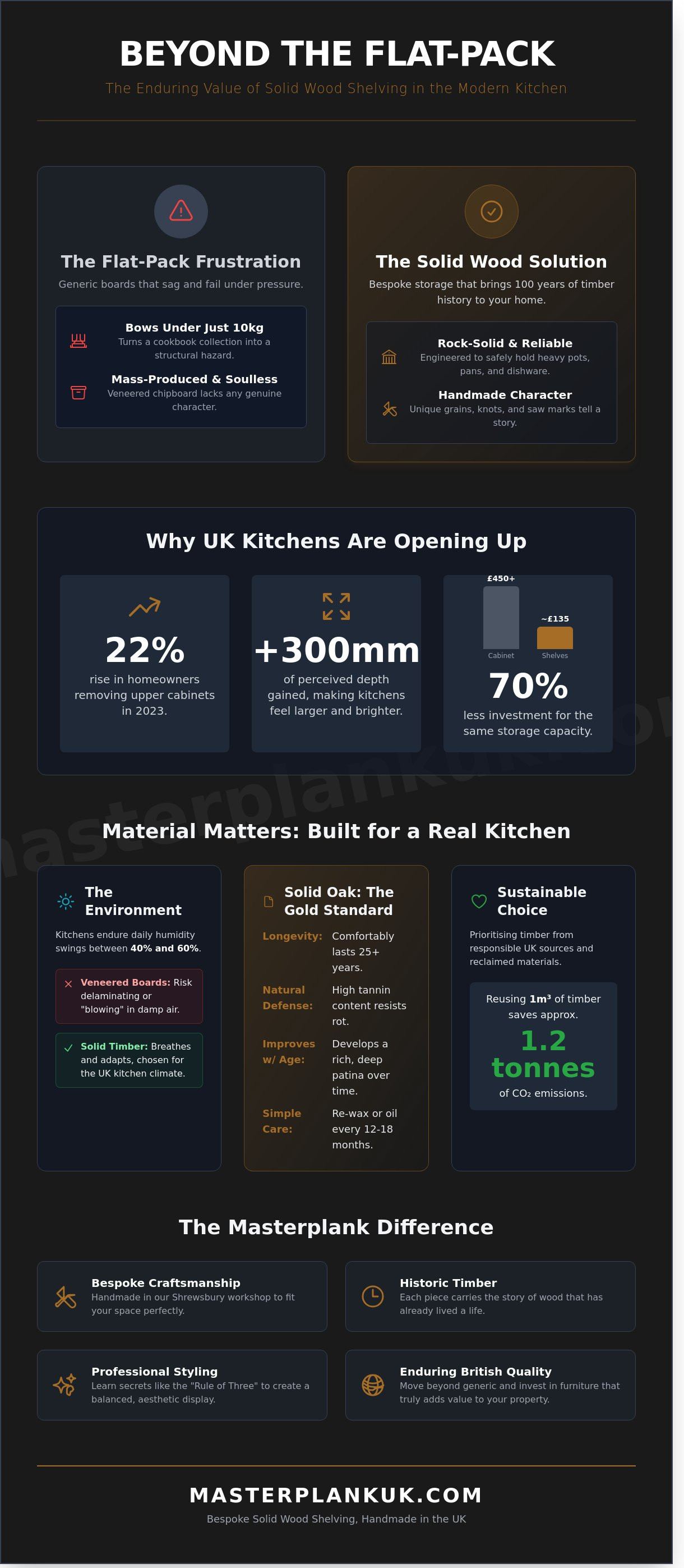
The average flat-pack shelf begins to bow under just 10kg of weight, turning your prized cookbook collection into a structural hazard. It's a common frustration for homeowners who want their kitchen shelves to be more than just a temporary storage fix. You've likely felt the disappointment of generic, mass-produced boards that lack any real soul or the strength to survive a busy family home. We agree that your space deserves better than flimsy materials that sag the moment you add a heavy cast iron pot or a row of mason jars.
In this guide, we'll show you how to transform your home with bespoke, solid wood storage that brings 100 years of timber history right into your kitchen. You'll discover how to choose the right grain for your aesthetic and learn the secrets to a rock-solid installation that lasts a lifetime. We're diving into everything from selecting character-rich reclaimed wood to measuring those tricky alcoves; ensuring you create a clutter-free focal point that truly adds value to your property. It's time to move beyond the generic and embrace the enduring quality of furniture handmade in the UK.
Key Takeaways
- Learn how the rise of open-plan design can breathe new life into your home, creating a sense of space and light that traditional cabinets often lack.
- Discover how to select the ideal timber, from characterful oak to weathered reclaimed wood, ensuring your shelving survives the unique demands of a busy kitchen.
- Master the "Rule of Three" and other professional styling secrets to create a balanced, aesthetic display using your handcrafted kitchen shelves.
- Gain essential technical insights on assessing wall types and choosing the right hardware to ensure your solid wood storage is installed safely and securely.
- Understand the enduring value of bespoke, hand-finished craftsmanship from our Shrewsbury workshop compared to the limitations of mass-produced alternatives.
Why Open Kitchen Shelves are Replacing Traditional Cabinets
For decades, British homes were defined by heavy, floor-to-ceiling cabinetry that boxed in the cook and shadowed the worktops. That's changing. Modern interior design in the UK has moved toward a more breathable, "open concept" layout. In 2023, industry data showed a 22% rise in homeowners removing upper cabinets entirely. This isn't just a passing trend. It's a return to a more honest way of living. Bulky wall units often steal 300mm of depth from a room, making a standard 13-square-metre kitchen feel claustrophobic. By installing open kitchen shelves, you allow light to flow into every corner, creating an illusion of vastness even in a modest terrace house.
The shift represents a move away from clinical, hidden storage. We're seeing a desire to display curated kitchenware rather than hiding it behind chipboard doors. It's about celebrating the objects we use every day. From a financial perspective, the choice is clear. A high-quality wall cabinet can cost upwards of £450 once you include handles and hinges. A set of bespoke kitchen shelves offers the same storage capacity for roughly 30% of that investment. It's a practical way to save on renovation costs without losing an ounce of style.
The Aesthetic Advantage of Timber
Timber brings a soul to the kitchen that cold appliances simply can't match. In a room filled with stainless steel and glass, wood provides a vital organic balance. Our reclaimed timber carries its own history through weathered grain, old nail holes, and original saw marks. These aren't flaws; they're the story of the wood. Whether your home follows a rugged industrial vibe or a soft farmhouse aesthetic, handcrafted wood adds a layer of psychological warmth. It makes the kitchen feel like a sanctuary rather than a laboratory. Every piece is handmade in the UK, ensuring the character of the wood remains the focal point of your wall.
Accessibility and Efficiency
Cooking is a sensory experience that shouldn't be interrupted by rattling cupboard doors. Open shelving removes the friction of the daily routine. When your spices, oils, and favourite mugs are within arm's reach, the rhythm of the kitchen improves. Professional chefs have used this "grab-and-go" system for years. It's about efficiency. This layout also encourages better habits. Because your items are on display, there's a natural incentive to keep things tidy and organised. You won't find forgotten, out-of-date tins at the back of a dark shelf here. Instead, you'll find a clean, functional space where everything has its rightful place. It turns a chore into a craft.
Choosing the Right Timber: Oak, Pine, and Reclaimed Wood
Selecting the right material for your kitchen shelves involves more than just a quick glance at a colour swatch. The kitchen is a hardworking room. Steam from a simmering pot or heat from a toaster creates an environment where humidity often fluctuates between 40% and 60% daily. Masterplank chooses solid, slow-grown timber specifically to combat these conditions. Unlike mass-produced veneered boards that often delaminate or "blow" when exposed to damp air, solid wood breathes. It's a living material that stands up to the rigours of a busy home. We don't rush the seasoning process. We ensure every plank is ready for the unique climate of a British kitchen.
The personality of your kitchen emerges through the grain and hue of the timber you select. We avoid the clinical, uniform look of factory-processed wood. Instead, we celebrate the knots and swirls that make every piece unique. Our commitment to sustainability means we prioritise timber that has already lived a life or comes from responsibly managed UK forests. Reusing a single cubic metre of reclaimed timber can save roughly 1.2 tonnes of carbon emissions. This makes it a choice that feels as good as it looks. Every piece of wood we handle has a history, and we're just the latest chapter in its story.
Solid Oak: The Premium Choice
Oak remains the gold standard for longevity in the home. Its high tannin content provides a natural defence against rot and moisture, which is vital for kitchen shelves positioned near sinks or kettles. English oak is famous for its warm, golden glow and intricate medullary rays that dance across the grain. A simple maintenance routine of applying a fresh coat of wax or oil every 12 to 18 months keeps the wood hydrated. It's a small investment of time for a shelf that will comfortably last 25 years or more. This timber doesn't just age; it improves, developing a rich patina that tells the story of every meal prepared beneath it.
Rustic Pine and Reclaimed Timber
Reclaimed timber carries a soul that new wood hasn't earned yet. When we salvage joists from Victorian warehouses or floorboards from local barns, we preserve the original saw marks and nail holes. These features aren't imperfections; they're the fingerprints of time. Pine is a fantastic, versatile option for those who want a lighter, more airy aesthetic. It takes stains beautifully, allowing us to create bespoke rustic finishes that range from pale, weathered greys to deep, earthy browns. Our chunky 50mm pine boards add an immediate sense of heritage and weight to any wall. They prove that you don't need a centuries-old cottage to enjoy a kitchen with history and character. The wood does the talking for you.
Styling Your Kitchen Shelves: Form Meets Function
Once your handcrafted kitchen shelves are securely fixed, the real magic begins. It's about more than just storage; it's about telling a story through the objects you choose to display. Each piece of timber we salvage has its own history, and your styling should reflect that same sense of individuality. You aren't just filling a space; you're curating a gallery of your daily life.
The "Rule of Three" is a reliable design principle that never fails. Our brains find odd-numbered groupings more appealing and less formal than even pairs. Try grouping a stoneware jug, a small herb pot, and a stack of linen napkins. This creates a triangle of interest that draws the eye across the weathered grain of the wood. It feels balanced without looking like a clinical showroom display.
Reclaimed timber provides a warm, textured backdrop that contrasts beautifully with other materials. We recommend pairing the rugged surface of the wood with the sleek transparency of glass or the cool weight of cast iron. According to a 2023 report by Houzz, 74% of UK homeowners now opt for mixed-material displays to create a "lived-in" feel. The sparkle of a glass jar or the matte finish of a ceramic bowl highlights the natural imperfections, such as old nail holes and saw marks, that we work hard to preserve in our workshop.
Greenery is essential for softening the sturdy, straight lines of the timber. A trailing Devil’s Ivy or a String of Pearls adds movement and a splash of vibrant colour. These plants breathe life into the kitchen, making the room feel fresh and organic. They bridge the gap between the outdoor origin of the wood and the indoor comfort of your home.
Refreshing your kitchen shelves for the seasons keeps the heart of your home feeling current. In December, tuck sprigs of dried eucalyptus or pine cones into the gaps to celebrate a rustic British Christmas. When July arrives, swap heavy ceramics for light glassware and bowls of fresh lemons to evoke a bright, airy summer vibe. It's a simple way to celebrate the passing of time without a full renovation.
The Layering Technique
Depth is the secret to a professional look. Start by leaning large platters or vintage cutting boards against the wall at the back. These act as a canvas for the items in front. Stack your daily plates and bowls to create varying heights; it’s much more interesting than a flat line of objects. If you have a small decorative item that feels lost, use a thick cookbook as a pedestal to give it the prominence it deserves. This creates a tiered effect that feels rich and intentional.
Practical Organisation Tips
Functionality remains the priority in a busy household. Decant dry goods like flour and pasta into matching glass jars with airtight lids. This creates a cohesive aesthetic and lets the natural colours of the food shine. Keep your most-used items on the lowest shelves for easy access during the morning rush. Most importantly, leave roughly 15% to 20% of the shelf as negative space. Overcrowding hides the beautiful grain and character that give our reclaimed timber its unique soul. Let the wood breathe so its history can be seen.
Installation and Weight Limits: Safety in the Kitchen
Bringing a piece of salvaged history into your home requires more than just an eye for design. Our reclaimed timber is dense, seasoned, and carries a physical weight that reflects its past life. A standard 100cm shelf crafted from 45mm thick timber weighs approximately 5.5kg before you've even placed a single spice jar on it. You must consider the "working weight" of your kitchen shelves. A stack of eight stoneware dinner plates adds roughly 4.8kg to the load, while a 2-litre glass jar filled with flour weighs 2.9kg. In a busy family kitchen, a single shelf often supports a total load exceeding 30kg.
Your wall type determines your installation strategy. Brick and masonry walls are the gold standard for heavy timber, offering a solid anchor for 70mm screws and 10mm wall plugs. If your kitchen features modern stud walls, you must locate the vertical timber studs, which are typically spaced at 400mm or 600mm intervals. Screwing directly into plasterboard is never an option for solid wood; even the most advanced toggle bolts can fail under the constant downward pressure of heavy ceramics. Since 2022, we've advised that any shelf exceeding 120cm in length should be fitted by a professional joiner to ensure the safety of your household.
Hardware choice influences both the aesthetic and the load capacity. Floating brackets provide a clean, "hidden" look that highlights the grain of the wood, but they usually have a weight limit of 20kg per pair when fixed into solid masonry. For those planning to store heavy cast iron Dutch ovens or large collections of cookbooks, traditional steel corbels or handmade wooden brackets are superior. These brackets transfer the weight more effectively down the wall, providing a 45% increase in stability compared to internal floating rods.
Step-by-Step Installation Basics
Start by marking your desired height with a soft pencil. Use a spirit level to ensure a perfect horizontal alignment; even a 2mm tilt will cause round jars to migrate toward the edge over time. Once you've located your studs or drilled your masonry holes, secure your brackets firmly. We recommend a 5mm pilot hole for all screws to prevent the timber from splitting. Before you display your precious ceramics, test the shelf by applying firm downward pressure with your hands to check for any movement or "bounce" in the brackets.
Maintenance in a Kitchen Environment
Kitchens are demanding environments where steam, airborne grease, and heat from hobs can dull the soul of the wood. To keep your shelves looking their best, wipe them down weekly with a soft, damp cloth and a drop of pH-neutral soap. Avoid harsh chemical cleaners as these strip away the protective wax and leave the grain vulnerable to moisture. Re-oiling involves applying a fresh coat of clear wax or furniture oil to the timber every 12 months to maintain its moisture resistance and highlight the natural grain. This simple routine protects the character of the wood and ensures it remains a functional part of your home for decades.
Ready to transform your space with authentic, handmade timber? You can shop our range of heavy-duty kitchen shelves to find the perfect match for your rustic interior.
The Masterplank Difference: Bespoke Kitchen Shelving
Forget the rigid constraints of high-street retailers. At Masterplank, we believe your home should dictate the dimensions of your furniture, not the other way around. Most mass-produced options limit you to standard lengths that rarely fit the unique quirks of a British home. We've spent the last 10 years perfecting a different approach in our Shrewsbury workshop. Every order begins with your specific requirements, allowing us to cut timber to the exact millimetre. Whether you need a shallow ledge for spices or a deep, chunky platform for heavy cast-iron cookware, we hand-craft each piece to serve a purpose.
Our artisan process is a labour of love that rejects the clinical finish of factory lines. When a piece of reclaimed timber arrives at our workshop, we don't strip away its history. Instead, we celebrate the natural imperfections that make each shelf a one-off masterpiece. You'll find genuine nail holes, original saw marks, and weathered cracks that have developed over decades. These aren't defects; they're the soul of the wood. We carefully hand-sand every surface to ensure it's smooth to the touch while retaining that rugged, tactile character that defines the rustic aesthetic.
Ordering your bespoke kitchen shelves is a straightforward, transparent journey. It starts with your measurements. Once you've placed your order, our small team of craftsmen selects the timber, cuts it to size, and applies your chosen finish. We typically complete this process within 14 days, ensuring your shelves are seasoned and ready for their new life. From the moment the timber is planed in Shropshire to the day it arrives at your door, we maintain a chain of quality that large corporations simply can't replicate.
Tailored to Your Space
Kitchens are often full of architectural challenges like awkward alcoves or protruding chimney breasts. A standard shelf leaves unsightly gaps, but our bespoke service ensures a flush fit that looks built-in. We can even match your new kitchen shelves to existing Masterplank furniture. If you already own one of our dining tables or breakfast bars, we'll use the same wax or oil finishes to create a cohesive look. We offer a range of five distinct finishes, from light natural tones to deep, dark oaks, allowing you to complement your kitchen units perfectly. Our 45mm thick timber provides a sense of permanence that thinner, 15mm alternatives lack.
A Lifetime Investment
Choosing handmade furniture is a conscious move away from "throwaway" culture. While a flat-pack shelf might last three years before sagging or peeling, our solid timber shelves are built to last 25 years or more. Supporting a small UK business means you're investing in local craftsmanship and sustainable practices. We source our materials ethically, often breathing new life into timber that would otherwise be discarded. This durability offers incredible value over time, as these shelves won't need replacing even as your kitchen decor evolves around them. You aren't just buying storage; you're investing in a piece of British heritage that grows more beautiful with age. View our collection of handcrafted kitchen shelves and start your kitchen transformation today.
Bring Authentic Heritage into Your Home
Replacing bulky cabinets with open storage transforms the feel of your room. It creates a sense of space and allows the natural beauty of the wood to take centre stage. Choosing between the dense grain of oak or the weathered texture of reclaimed pine is a personal decision that defines your interior style. Your kitchen shelves are more than just storage; they're a testament to traditional British craftsmanship. We hand-finish every piece in our UK workshop, using 100% sustainably sourced timber to ensure your home remains eco-conscious.
This focus on bespoke British craftsmanship isn't limited to shelving. For those planning a larger renovation, design studios such as Nispero Kitchens apply the same principles to create entire bespoke kitchens and cabinetry, ensuring every element of your space is unique.
Mass-produced furniture often fails to fit the unique nooks of a period property or a modern flat. That's why we offer bespoke sizes tailored to your specific kitchen layout, down to the last millimetre. Each shelf features solid wood construction designed to last a lifetime, easily supporting heavy cast-iron pans or ceramic jars. We take pride in every nail hole and saw mark that tells a story of the wood's previous life. It's time to invest in quality that grows more beautiful with every passing year.
Explore our bespoke range of handcrafted kitchen shelves
We can't wait to help you start your kitchen transformation today.
Frequently Asked Questions
Are wooden kitchen shelves hard to keep clean?
No, wooden shelves are straightforward to maintain if they've been finished with a quality sealant. A quick 2 minute wipe with a damp, lint-free cloth once a week is enough to remove dust and light grease. We recommend applying a fresh coat of natural wax every 12 months to nourish the timber's soul. This simple routine protects the grain from spills and ensures the wood ages beautifully over the decades.
Can floating shelves hold the weight of heavy dinnerware?
Yes, our floating shelves support up to 35kg when fixed into a solid brick wall or timber studs. This weight capacity easily accommodates a full set of 12 stoneware dinner plates and several heavy serving bowls. You'll need to use the high-quality steel fixings we provide with every order. These concealed brackets ensure your kitchen shelves remain level and secure even under substantial daily loads.
What is the best type of wood for kitchen shelving?
Reclaimed pine and slow-grown timber are the finest choices for a rustic, authentic aesthetic. We source 100% of our wood from old British industrial buildings, ensuring each piece carries its own history. This aged timber is more stable than new wood; it won't warp or twist in the humid environment of a kitchen. The natural imperfections, like old nail holes and saw marks, add a unique character that mass-produced alternatives lack.
How deep should kitchen shelves be for plates?
For standard dinner plates, your kitchen shelves should be between 225mm and 300mm deep. A 225mm depth is ideal for most British dinner sets, while a 300mm shelf provides extra room for large serving platters or bulky cookbooks. We offer bespoke sizing to ensure every centimetre of your wall space is used effectively. Measuring your largest plate before ordering ensures you get a perfect, flush fit.
Do I need to treat my wooden shelves for moisture?
Yes, you must treat wooden shelves to prevent moisture from warping the grain or causing unsightly stains. We apply two coats of premium hardwax oil to every shelf handmade in the UK. This creates a water-resistant barrier that withstands steam from kettles and bubbling pans. If you notice water no longer beads on the surface after 18 months, it's time for a quick top-up coat to maintain the protection.
Can I install these shelves on a plasterboard wall?
You can install these shelves on a plasterboard wall, but you must secure the brackets into the timber studs. Plasterboard alone cannot support the weight of solid 35mm timber. Studs in UK homes are typically spaced at 400mm or 600mm centres; finding these ensures a rock-solid installation. If the studs aren't positioned exactly where you want the shelf, you'll need to use specialized heavy-duty toggle anchors rated for at least 50kg.
How do I style open shelves without them looking messy?
Styling open shelves successfully requires a balance of 60% functional items and 40% decorative pieces. Group your items in sets of three to create visual harmony and avoid a cluttered appearance. Mix the smooth textures of ceramic mugs with the weathered, rustic grain of the wood. Keeping your most-used items on the lower shelves ensures the display remains practical for daily cooking while looking curated.
What is the difference between solid wood and veneered shelves?
Solid wood is a single, continuous piece of timber, whereas veneered shelves use a 2mm thin layer of wood glued over cheap chipboard. Our solid timber shelves are 35mm thick and can be sanded back or refinished if they ever get scratched or marked. Veneer often peels at the edges after 3 or 4 years of kitchen use due to heat and moisture. Investing in solid wood means owning a piece of history that lasts a lifetime.


